Hello, dear readers, and welcome to the inaugural post for "Curious Cards!" As a reminder, this is going to be a weekly ongoing series about tarot. Each week, I'll draw a card to write about. I'll show some examples of how different artists have rendered the card in different decks, share some traditional interpretations of the card, my own thoughts on it, and will probably also pull in thoughts from other tarot readers I admire (with references, of course - expect footnotes).
Hilariously, the first card I pulled is one of the cards that people often find the most challenging in the deck: the 10 of Swords.
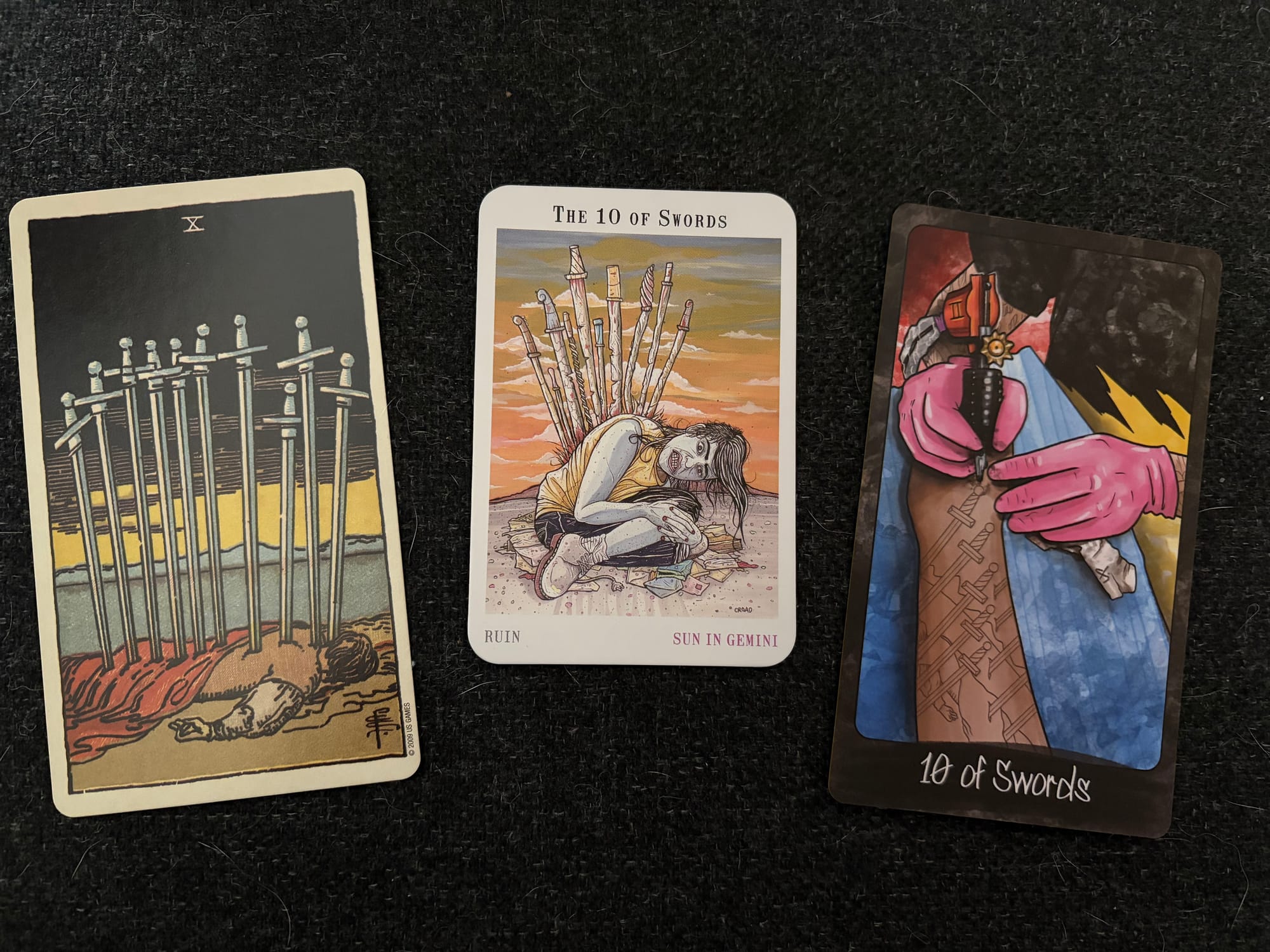
Obviously, this card is...intense. Sometimes, it feels like the deck saying, "yep, this feels Bad." It's hitting rock bottom, it's the feeling of defeat, of utter ruin, of being pinned to the ground by your troubles. In the words of Charlie Claire Burgess, "This card appears when our brain chemicals are circling the drain, when our nerves are so fried that we can't function and our emotions are so massive that we go numb."[1] Other times, it can veer into the realm of melodrama, as described by Meg Jones Wall: "It's a little overdramatic, bordering on ridiculous, but we have lost all sense of perspective and are completely caught up in a personal, twisted narrative of our victimhood."[2]
It's a hard card to have come up in a reading. And...sometimes it makes me laugh.
The first time I read tarot at a maker's market, I had started the day using the This Might Hurt Tarot. At some point during the day, I had the thought, "There are a bunch of families with kids here. Maybe I should switch to the other deck I brought in case a kid wants a reading. What if I pull the 10 of Swords? That would be a lot." This is how the 10 of Swords is depicted in each of the decks I had with me that day:
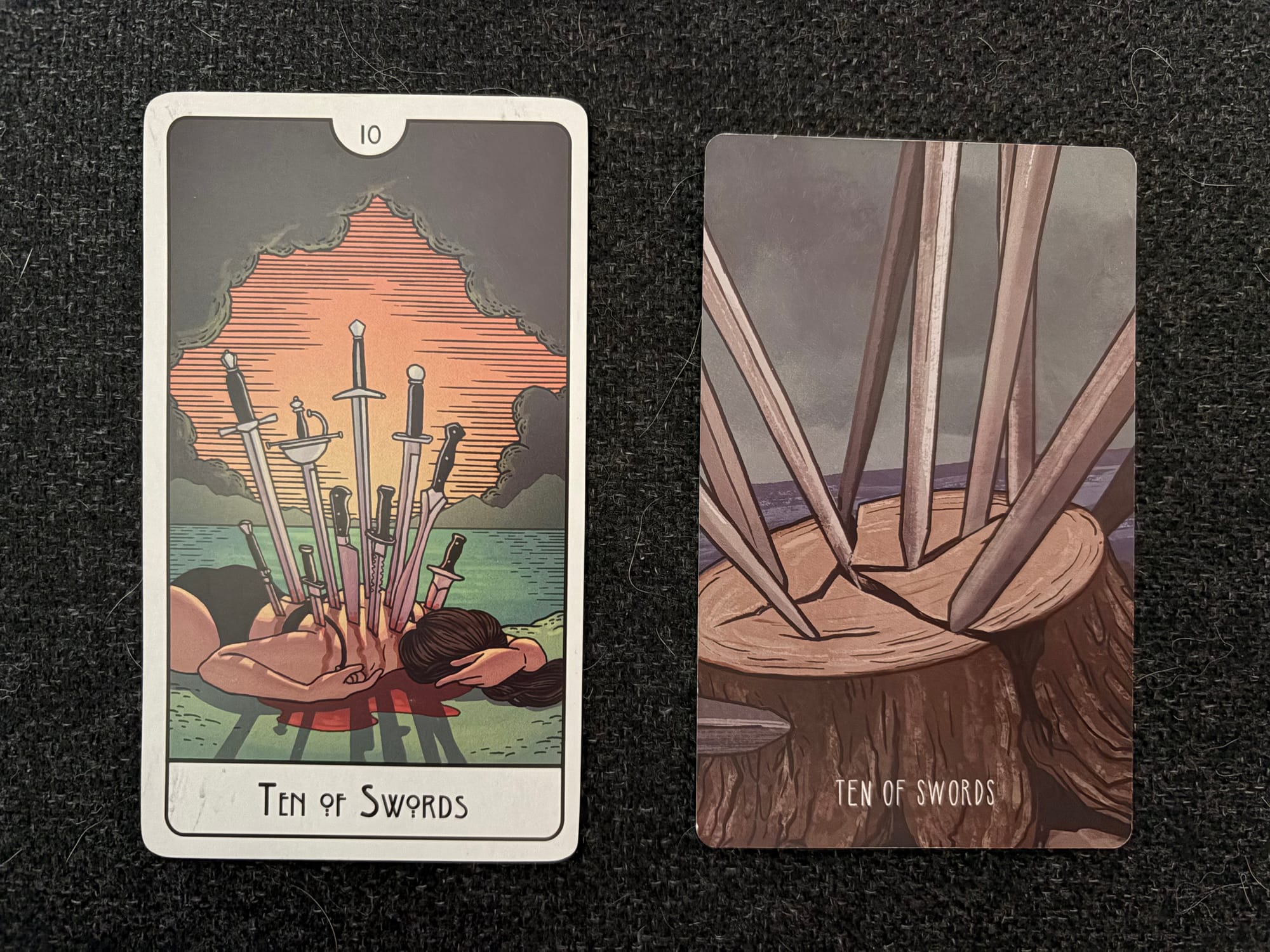
Did I switch decks?
No.
Did a kid come up to me for a reading?
Yes.
Did I immediately pull the much more disturbing version of the 10 of Swords?
Also yes.
This kid was probably 8 or 9 years old. I pulled the card so that I could see what it was before I set it down. I almost put it back and tried again...but the kid was watching me, and I knew they'd know I wasn't being honest with them, and that didn't feel right. Their mom was busy trying to get my Venmo QR code to work to pay for the reading and was not paying attention to what was happening. I put the card down for the kid to see.
"This can be a kind of scary card, I know," I said. "It says that sometimes things are really hard. But also, sometimes the hard things that happen make space for something better to come through."
It was an oversimplification. There are other things that, in retrospect, I wish I had said. But for one of my first live readings for a stranger, and my first reading for a kid, I felt pretty good about how I explained it. And when their mom finished paying and asked the kid what their reading had said, they were able to repeat back my explanation, which makes me think I didn't totally traumatize them.
Here are some other things I would say if the same situation came up again:
- Sometimes things are hard, and it's okay to say that.
- Sometimes when things are really hard, you just need to let yourself be sad and maybe even a little bit dramatic about it.
- Sometimes we need to let go of parts of ourselves in order to grow into the person we want to become, and that growing can hurt. It's okay to to be sad about that.
I don't want to lean toward toxic positivity into my readings, but I will admit that I do tend to look for the potential positive side of any card. For me, the promise in the 10 of Swords is in its finality. Things are bad. But they're not likely to get worse. They might stay bad for a while. It might feel like the bad will never end. But everything changes, eventually. And I stand by what I told that kid - while I don't believe that "everything happens for a reason," I do believe that sometimes the hard stuff happening, the loss and the letting go, makes room for other things to come into our lives. And since things are as bad as they're going to get, there's at least a chance the new thing will be better.
Tens in the tarot are the culmination of the journey of each suit. They're the end of a cycle. (Even in the Major Arcana, the Wheel of Fortune - a card all about cycles and change - is number 10.) Swords are the suit of communication, of thought and intellect, of logic, of insight, of knowing. They cut through the bullshit to get to the truth. The 10 of Swords doesn't mince words. It is honest about the devastation that can result from realizing that something you thought you knew turned out to be false, even if it was true before. As Charlie Claire Burgess states, "The Ten of Swords confronts us with one of the most challenging and most mature tasks of the mind: accepting a reality that we don't want to be true."[3] There is genuine loss here. Something has died, and is not coming back, at least not in the form that it existed before. And even in that acknowledgement of the loss, the 10 of Swords invites us to examine those things we held as unshakable truths that have now been rattled, so that we can move forward. As Meg Jones Wall puts it, "if we're willing to be critical of our own choices, if we're able to own up tot he choices we've made and the denial we've clung to that landed us here, there's potential for escape, healing, and even new discoveries."[4]
I feel like pulling the 10 of Swords as the first card for this blog series is actually kind of encouraging, through this lens. It feels like an acknowledgement that things are really hard right now, not just for me, but collectively. It feels like permission to say that I've been struggling. And it feels like a promise - that I've reached the end of a cycle, and something new (hopefully better, but at least different) is coming. Charlie Claire Burgess ends their chapter on the 10 of Swords by saying, "There is the bone-deep knowledge that as hard as this it, as much as this hurts, you will survive this. You will figure out what's next waiting on the other side of the night."[5]